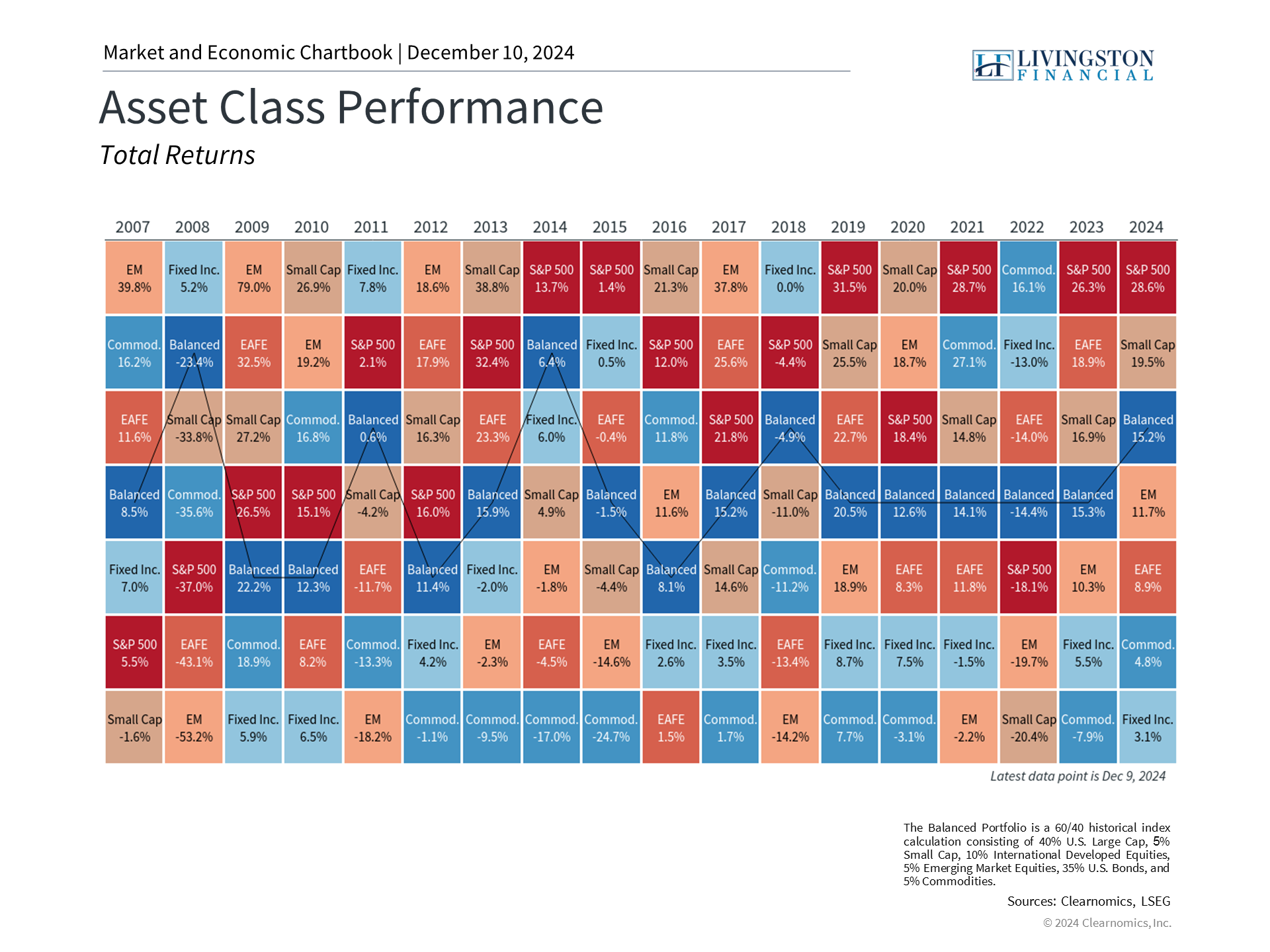
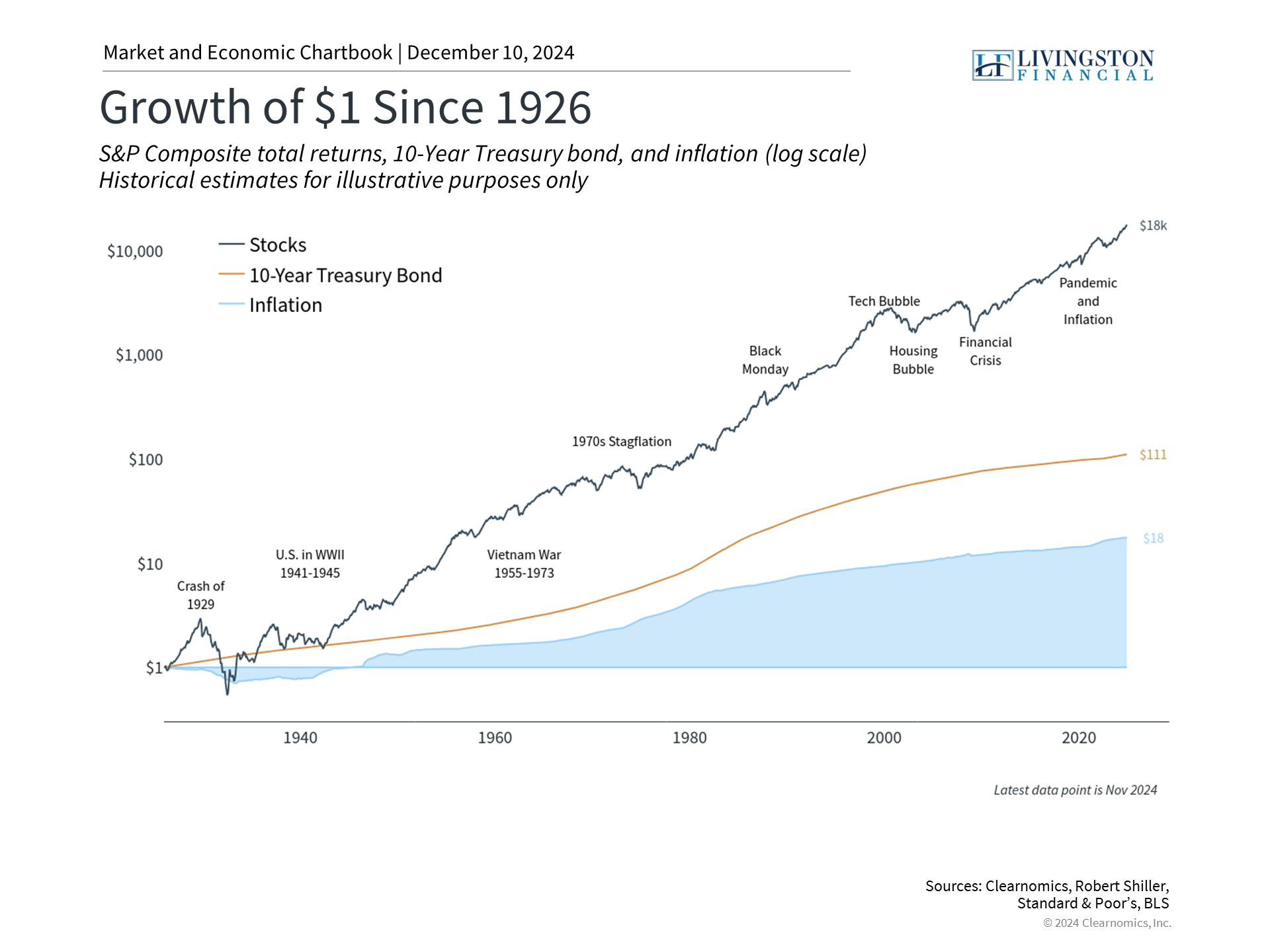
"Our worst misfortunes never happen, and most miseries lie in anticipation," wrote 19th century author Balzac - a sentiment that perfectly describes the investment climate of 2024. Despite widespread fears of recession, market downturns, and political instability, many of these concerns never materialized. As we conclude the year, the reality has proven quite different from these anxieties. The S&P 500 has reached new heights, inflation has moderated, economic growth remains robust, and the Federal Reserve has initiated rate cuts. This demonstrates how excessive worry can potentially derail sound investment decision-making. While recent years have been characterized by extremes - from the market lows of 2020 and 2022 to the remarkable recoveries of 2021, 2023, and 2024 - 2025 presents an opportunity to restore equilibrium. This applies equally to market dynamics and investor psychology. Looking ahead, several factors warrant attention: elevated market valuations, uncertainty surrounding interest rate trajectories, questions about artificial intelligence's impact, and rising geopolitical tensions. Additional unforeseen events will likely emerge to test investor resolve. However, the past year offers valuable lessons for navigating 2025 and beyond. Here are five key insights to help maintain perspective during periods of market uncertainty. 1. Economic resilience has bolstered market performance
Contrary to widespread concerns about a "hard landing" due to restrictive monetary policy, the economy has demonstrated remarkable resilience. Inflation has retreated toward normal levels, employment remains strong, and growth has exceeded expectations - outcomes few anticipated a year ago. Current economic indicators paint a positive picture: inflation has moderated to 2.6% annually, unemployment stands at just 4.2%, and the economy has added 2.3 million jobs in twelve months. Third-quarter GDP growth reached 2.8%, surpassing most forecasts. This economic strength has supported broad-based asset appreciation. Domestic and international equities have climbed higher, bonds have recovered as rates stabilized, and alternative assets like gold and Bitcoin have achieved record levels. Nevertheless, challenges persist. Consumer spending may decline as savings diminish and debt levels remain elevated. Assets that have seen substantial appreciation may face increased volatility. In this environment, focusing on fundamental factors becomes crucial. 2. Current valuations emphasize diversification importance
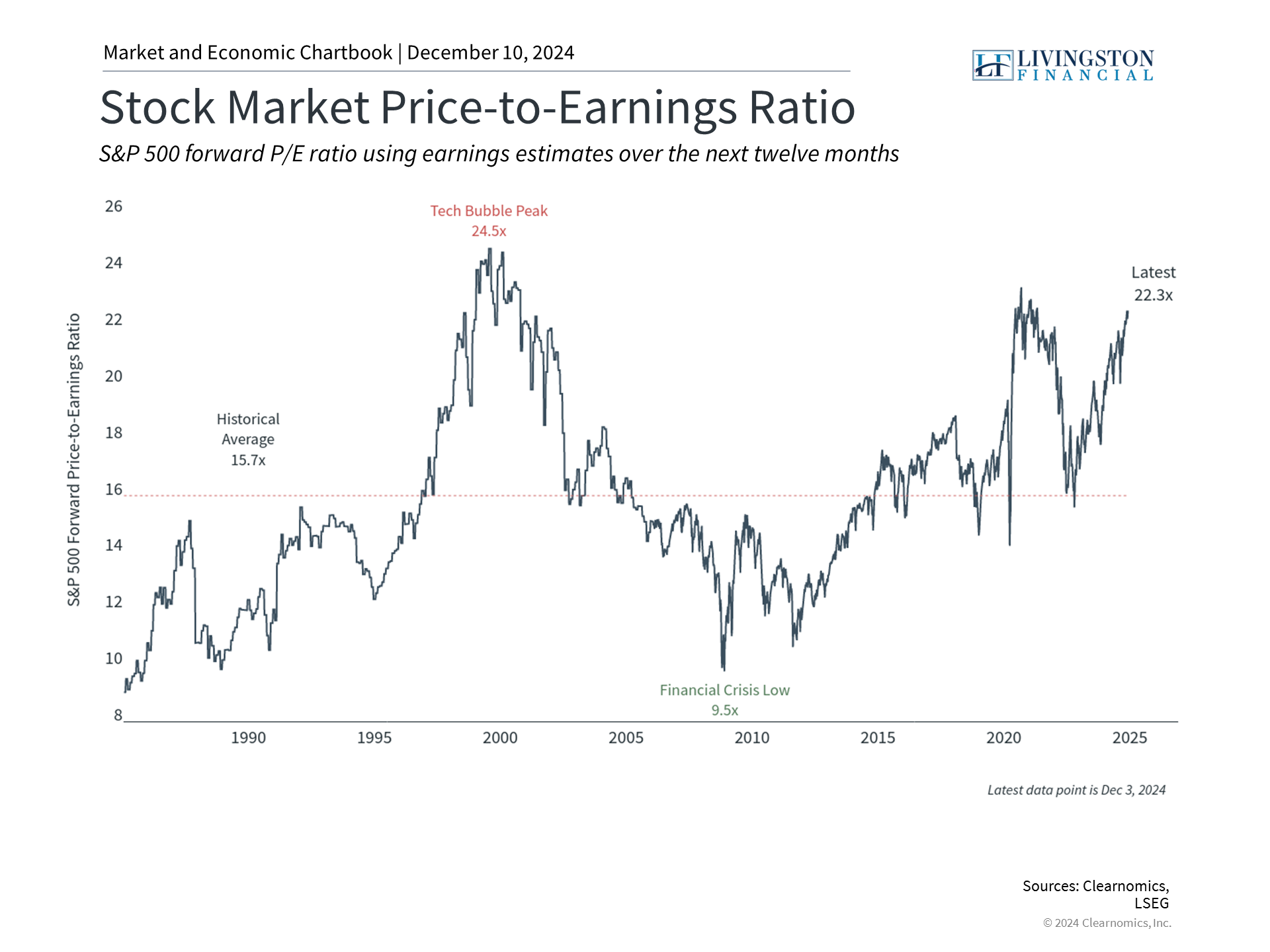
Corporate performance has been impressive, with S&P 500 earnings growing 8.6% over twelve months to reach $236 per share. However, market gains have outpaced earnings growth, pushing valuations higher. The current price-to-earnings ratio stands at 22.3, significantly above the 15.7 historical average and approaching the 24.5 peak seen during the dot-com era. These elevated valuations carry implications for future returns and portfolio strategy. This environment emphasizes the importance of diversification across asset classes and market segments. While artificial intelligence-related investments have led recent gains, market participation has broadened, with all eleven sectors posting positive returns this year. Given the difficulty in predicting sector leadership, maintaining broad market exposure can help reduce portfolio volatility. 3. Monetary policy shift supports market outlook
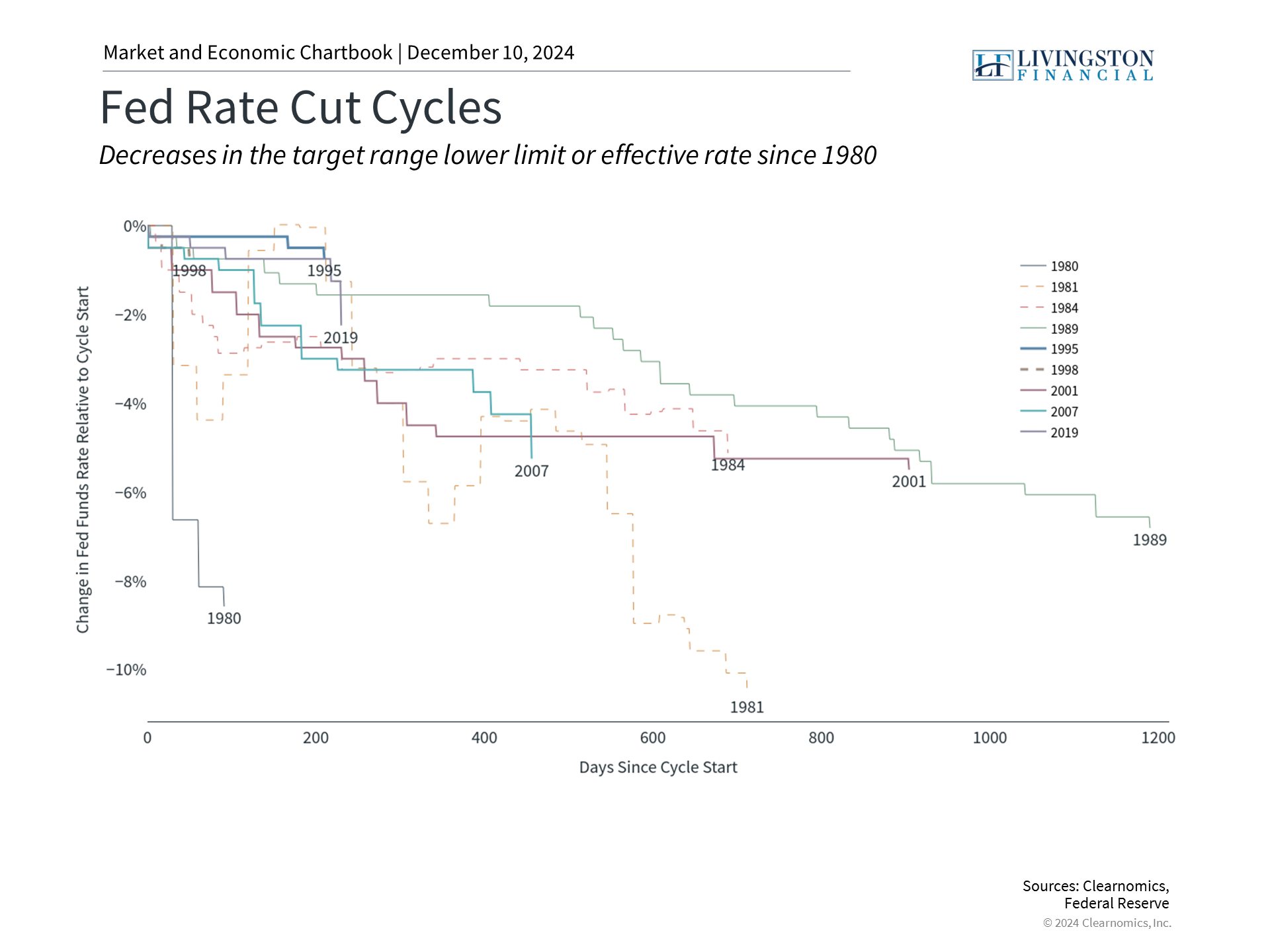
The Federal Reserve's transition to rate cuts began in September, with a cumulative reduction of 0.75%. Markets anticipate three to four additional cuts through 2025. While the precise timing and magnitude of future cuts remain uncertain, the shift from monetary headwinds to tailwinds is significant. Lower rates typically support economic activity and can benefit both corporate earnings and market returns over time. The evolving rate environment may particularly benefit fixed income investments as inflation and growth stabilize. Lower short-term rates combined with steady longer-term rates could create opportunities for both income and price appreciation in diversified portfolios. Rather than attempting to predict individual Fed decisions, investors should focus on the broader policy trajectory as attention shifts to the incoming administration's agenda. 4. Policy implementation becomes market focus
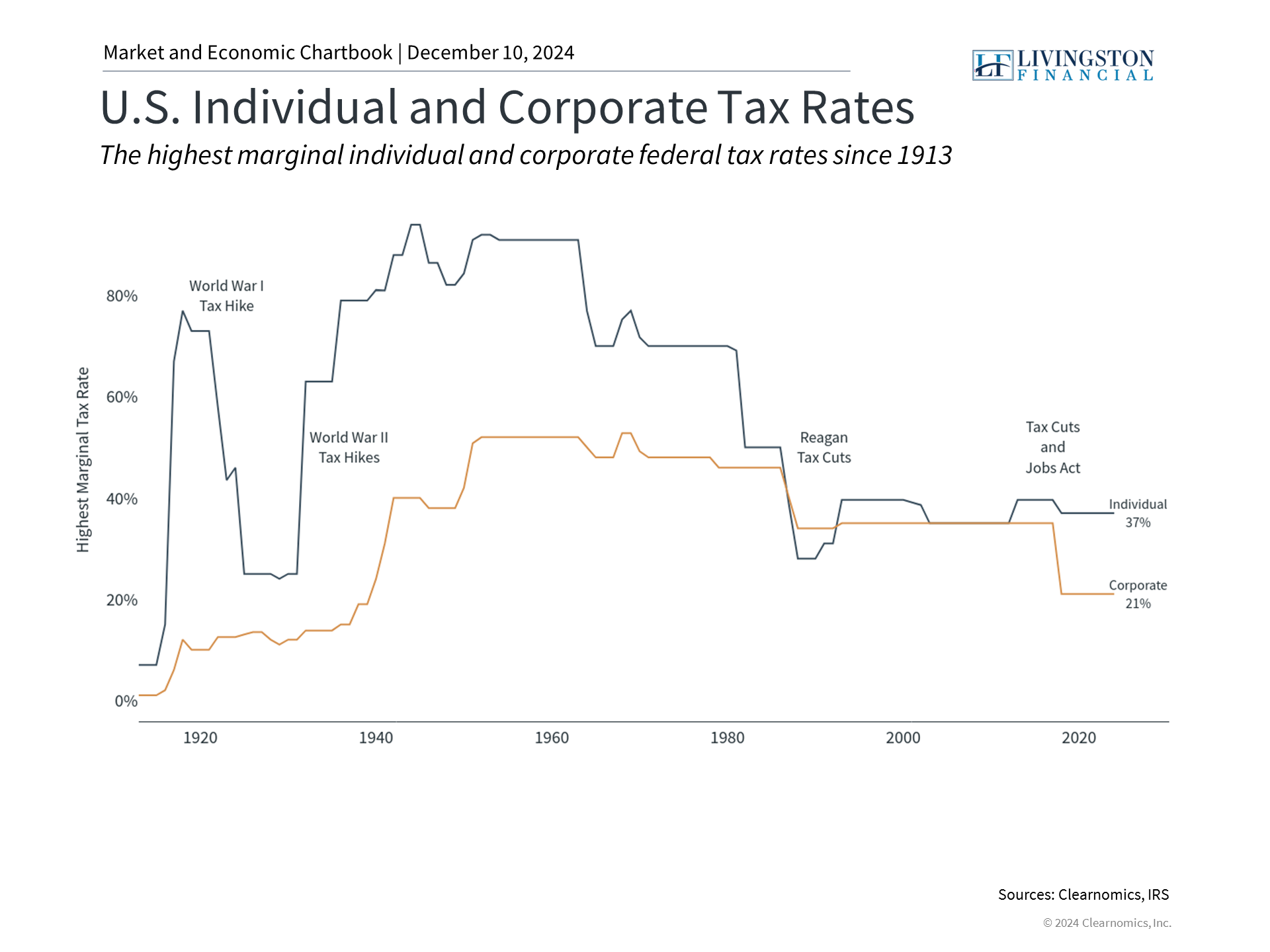
The resolution of election uncertainty has supported market gains, though the nation remains politically divided. History demonstrates that markets can thrive under either party's leadership, as economic fundamentals typically matter more than political affiliation. Tax policy clarity has emerged with the likely extension of key provisions. This affects personal, corporate, and estate taxation, making now an ideal time for comprehensive financial planning. Trade and fiscal policy will remain in focus. While new tariffs may be implemented, previous experience suggests worst-case scenarios often don't materialize. Similarly, while the $36 trillion national debt warrants attention, markets have historically performed well despite deficit concerns. 5. Long-term perspective remains crucial
The past year reinforces that markets can advance despite prevalent concerns. While brief pullbacks occurred in April and August, overall market resilience prevailed, supported by economic strength and innovation across sectors. Historical evidence demonstrates that wealth creation occurs over years and decades rather than months. Even retirees benefit from maintaining a long-term outlook that helps contextualize short-term events. The bottom line? After a strong 2024, investors should prioritize portfolio balance in 2025. History shows this approach best positions investors to manage unexpected events while pursuing long-term financial objectives. | |||||
Securities and Advisory services offered through LPL Financial | A Registered Investment Advisor | Member FINRA/SIPC Copyright (c) 2024 Clearnomics, Inc. All rights reserved. The information contained herein has been obtained from sources believed to be reliable, but is not necessarily complete and its accuracy cannot be guaranteed. No representation or warranty, express or implied, is made as to the fairness, accuracy, completeness, or correctness of the information and opinions contained herein. The views and the other information provided are subject to change without notice. All reports posted on or via www.clearnomics.com or any affiliated websites, applications, or services are issued without regard to the specific investment objectives, financial situation, or particular needs of any specific recipient and are not to be construed as a solicitation or an offer to buy or sell any securities or related financial instruments. Past performance is not necessarily a guide to future results. Company fundamentals and earnings may be mentioned occasionally, but should not be construed as a recommendation to buy, sell, or hold the company's stock. Predictions, forecasts, and estimates for any and all markets should not be construed as recommendations to buy, sell, or hold any security--including mutual funds, futures contracts, and exchange traded funds, or any similar instruments. The text, images, and other materials contained or displayed in this report are proprietary to Clearnomics, Inc. and constitute valuable intellectual property. All unauthorized reproduction or other use of material from Clearnomics, Inc. shall be deemed willful infringement(s) of this copyright and other proprietary and intellectual property rights, including but not limited to, rights of privacy. Clearnomics, Inc. expressly reserves all rights in connection with its intellectual property, including without limitation the right to block the transfer of its products and services and/or to track usage thereof, through electronic tracking technology, and all other lawful means, now known or hereafter devised. Clearnomics, Inc. reserves the right, without further notice, to pursue to the fullest extent allowed by the law any and all criminal and civil remedies for the violation of its rights. |
2025 Investment Landscape: Finding Balance in an Ever-Changing Market help